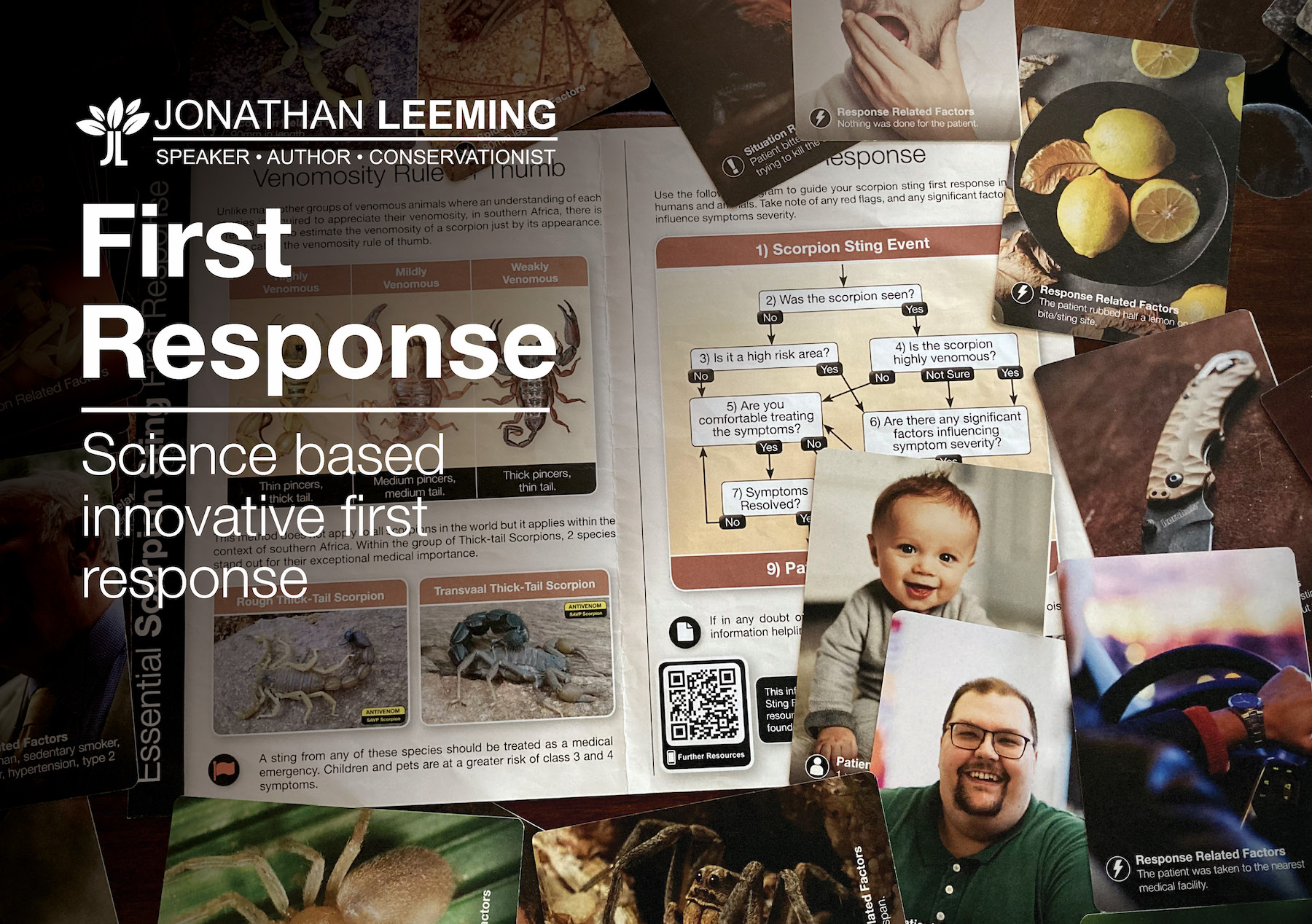
Southern African is home to 8 different general of scorpions. Each genera share common traits including various aspects of natural history, but also venomosity. The following are general guidelines of venomosity per genera of scorpion.
Buthidae
- Thick-Tail Scorpions (Parabuthus sp.) - A sting from small species of highly venomous scorpions typically results in class 2 or 3 symptoms. A sting from a large species of scorpion such as the Granulated Thick tail Scorpion (Parabuthus granulatus), Transvaal Thick-Tail Scorpion (Parabuthus transvaalicus) and the Hairy Thick-Tail Scorpion (Parabuthus villosus) may result in class 4 symptoms.
- Lessor Thick-Tail Scorpions (Uroplectes sp.) - A sting from these small weakly venomous scorpions typically results in class 2 or symptoms.
- Nomad Scorpions (Hottentotta sp.) - A sting from these weakly venomous scorpions typically results in class 2. A sting from the larger Hottentotta trilineatus results in class 3 symptoms.
- Pseudolychas - A sting from these small weakly venomous scorpions tipically results in class 1 or 2 symptoms.
- Karasbergia - A sting from these weakly venomous scorpions tipically results in class 2 or symptoms.
- Afrolychas - A sting from these weakly venomous scorpions tipically results in class 2 or symptoms.
Hormuridae
- Rock Scorpions (Hadogenes sp.) - A sting from these weakly venomous scorpions typically results in class 1 symptoms.
- Creeping Scorpions (Opistacanthus sp.) - A sting from these weakly venomous scorpions typically results in class 1 symptoms.
- Lessor Creeping Scorpions (Cheloctonus sp.) - A sting from these weakly venomous scorpions typically results in class 1 symptoms.
Scorpionidae
- Opistophthalmus (Burrowing Scorpions) - A sting from these mildly venomous scorpions typically results in class 2 or in the case of large species, class 3 symptoms.
Note that the following represents a typical sting that does not take factors that influence symptoms severity into consideration.