Although this article focuses upon domestic cats and dogs, the associated principles and factors influencing symptoms severity, apply to all mammalian animals (humans, domestic and wild).
South Africa is home to about 2350 species of named spider, with only 19 species considered as medically significant. They live in the natural environment and also in our homes. They are a familiar sight to many people, yet as one of the most feared creatures on Earth, spiders had a special place in our values and beliefs.
Spider bites in dogs and cats is a challenge to quantify and study and there is little to no reliable data to draw from. Bites are likely to be more common than in humans, but at the same time, often goes undiagnosed. When cats or dogs locate a spider, they rarely move away to a safe distance. They often head for it and try to kill it which may result in them being bitten.
Just as with spider bites in humans, misdiagnosis is very common. If the patient did not watch the spider bite them it is unlikely to be a spider bite. The biggest challenge of spider bite first response animals is how frequently a bites go unnoticed by the pet owner.
Spiders as a group of venomous creatures posses 2 kinds of venom:
There are similarities between how the factors that influence symptoms severity relate to humans and animals. The important differences that influence the outcome of a bite are the following:
Diagnosis is based upon signs of agitation and abnormal behaviour. The following symptoms are an indication of a neurotoxic spider bite (in particular, Button Spider bite):
The following symptoms are an indication of a cytotoxic spider bite:
It is only by interpreting an animals behaviour that the severity of symptoms can be evaluated.
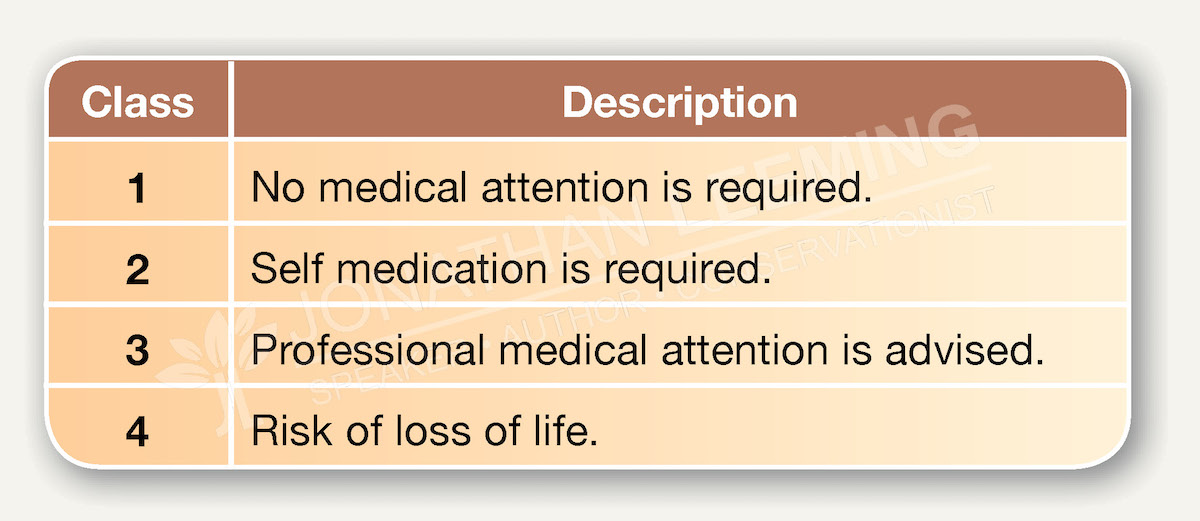
A major challenge in responding to a scorpion sting in cats and dogs is their inability to clearly communicate the level of symptoms that they are experiencing. As a consequence, class 1 or 2 symptoms usually go unnoticed, while class 3 and 4 symptoms are often diagnosed late.
The following factors make diagnosis in animals challenging:
It is important to recognise a spider bite especially in smaller animals, and when professional medical attention is required. If a spider bite is suspected then the bite should be treated as a medical emergency.
It is also important to be aware of any animal related red flags. In the case of class 3 or 4 symptoms, antivenom may be administered to prevent death of the animal. The same antivenom, at the same dose and in the same way, is given for animals as for humans. It has been noted that dogs that have received a sufficient dose of antivenom have fully recovered within 6 hours. Although it is illegal to give a human expired antivenom, it is acceptable to administer expired antivenom to an animal.
I'm on a mission to reduce the burden of spider bites and scorpion stings across Southern Africa!
Public Events | Books & Workbooks | Presentations | Activities |Professional Development | Shop